
George Cobb
George Cobb was a leading figure in statistics education whose ideas influenced both individual educators and the profession as a whole. His articles and presentations were widely cited, and he was known for combining insight with wit and clarity. In 2005, he became the first recipient of what is now known as the George Cobb Lifetime Achievement Award in Statistics Education.
In 1987, George wrote one of the most influential papers in statistics education: a review of 16 textbooks published in the Journal of the American Statistical Association. The paper included one of his best-known observations: “Judge a book by its exercises, and you cannot go far wrong.”
The titles of George’s many talks offer a glimpse of his playful and inquisitive mind:
- “Three Ways to Gum Up a Statistics Course”
- “Brains, Elasticities, and Slime: The Importance of Transformations in Data Analysis”
- “Introductory Statistics: The New Clothes Are There, but Is There an Emperor Inside?”
- “The Objective Format Question: Dead Horse, Old Bathwater, or Overlooked Baby?”
- “Unexpected Connections: A Sequence That Starts Like Fibonacci, a Triangle That Adds Like Pascal, and the Classical Drunkard’s Walk”
- “Is Statistics Getting Harder as It Gets Softer?”
- “Against Fairness”
- “Drug Deals and Jury Wheels: Probability and Statistics Go to Court”
Behind that playfulness was a careful command of language. George wrote deliberately, giving close attention to each word and sentence so his ideas would be both precise and engaging.
George majored in Russian literature at Dartmouth, where he was intrigued by the patterns in Russian poetry. He later earned his PhD in statistics from Harvard under the supervision of Art Dempster. He spent most of his career at Mount Holyoke College, teaching there from 1974 until his retirement in 2009. He became the Robert Rooke Professor of Mathematics and Statistics and served for several years as dean of studies.
George was widely respected as a teacher and curriculum innovator. He created a course in Markov chain Monte Carlo methods long before MCMC was commonly taught to undergraduates. He also incorporated active learning throughout his courses, guided by a conviction captured in one of his most frequently quoted observations: “Shorn of all subtlety and led naked out of the protective fold of educational research literature, there comes a sheepish little fact: Lectures don’t work nearly as well as many of us would like to think.”
In 2005, George received the Lifetime Achievement Award in Statistics Education from the Consortium for the Advancement of Undergraduate Statistics Education at the first US Conference on Teaching Statistics. In his after-dinner keynote address, he argued for replacing normal-theory-based inference with randomization-based inference, drawing on computing power and returning to principles of inference advanced by R. A. Fisher.
He later developed this argument in “The Introductory Statistics Curriculum: A Ptolemaic Curriculum?,” published in the inaugural issue of Technology Innovations in Statistics Education. That work also informed his collaboration with Nathan Tintle and others on Introduction to Statistical Investigations, a textbook built around randomization-based methods.
George was an active member of the American Statistical Association and helped broaden the role of statisticians from liberal arts colleges within the association. He was elected an ASA Fellow in 1993, served as an ASA vice president beginning in 2004, and received the association’s highest honor—the Founders Award—in 2007.
As a longtime member of a mathematics department, George also contributed extensively to the Mathematical Association of America and helped strengthen the relationship between the MAA and ASA. He served as the first chair of the ASA/MAA Joint Committee on Undergraduate Statistics.
George helped write the 2005 Guidelines for Assessment and Instruction in Statistics Education Report, commonly known as GAISE. That work built on a 1992 report he authored for the MAA volume Heeding the Call for Change. The earlier report offered three forward-looking recommendations: teach statistical thinking; emphasize data and concepts over theory and recipes; and foster active learning.
George later served as principal investigator for a National Science Foundation grant to the MAA that funded an extensive series of workshops for mathematicians who taught statistics—a common arrangement at the time. The workshops emphasized those same three recommendations.
With David Moore, George also co-authored two articles for The American Mathematical Monthly—“Mathematics, Statistics, and Teaching” and “Statistics and Mathematics: Tension and Cooperation”—examining the relationship between statistics and mathematics. The articles explored how the two disciplines approach context and abstraction differently and considered the implications of those differences for statistics education.
George was also the first statistician from a liberal arts college to serve on the Committee on Applied and Theoretical Statistics of the National Academies of Sciences, Engineering, and Medicine.
For 30 years, George served as an expert witness in legal cases, most of which involved workplace discrimination. One case concerned a hospital nurse accused of murdering patients. It led George to co-author an article with the opposing expert witness for the collection Statistics: A Guide to the Unknown. Their collaboration after serving on opposite sides of the case reflected George’s Quaker values and his commitment to thoughtful professional exchange.
George was also a prolific textbook author. His 1998 book, Introduction to Design and Analysis of Experiments, introduced experimental design and analysis of variance to undergraduate and graduate students with no previous background in statistics. He co-authored Statistics: From Data to Decision with Dick Scheaffer and Ann Watkins, Introduction to Statistical Investigations with Nathan Tintle and others, and STAT2: Building Models for a World of Data with Ann Cannon and others.
More about George’s life, career, and contributions can be found in a Journal of Statistics and Data Science Education article by Jeff Witmer, an interview George gave to the Journal of Statistics Education, and a recording of a memorial session. His influence is also evident in the following reflections from friends and colleagues:
“ George truly was the Mozart of our profession: profoundly original, lyrical, incomparably influential, and delightfully complex. ”
— Ann Watkins“ George changed the way we thought about teaching and wrote in ways that were new and stunning to those of us who read him. ”
— Paul Velleman“ George had a rare gift for entertaining people while making them think at the same time. He often told audiences they were doing it all wrong and needed to change, yet they walked out of his talks laughing and smiling. ”
— Bob Hayden“ Judge a statistics educator by how closely they resemble George Cobb and you cannot go far wrong. ”
— Jeff Witmer
(1947 – 2020)
In George’s Words ...
The distinction between how we think and what we do needs to be recognized more explicitly. What we do is constrained by reality. How we think is not, and should not be. To borrow from Robert Browning (1855), our reach should exceed our grasp.”
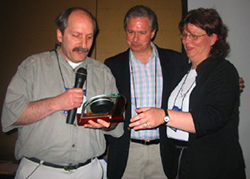
Center: George Cobb
List of Donors
Ming-Wen An
Benjamin Baumer
Nancy Boynton
Andrew Bray
Robert Carver
Abhishek Chakraborty
Beth Chance
Laura Chihara
Mine Dogucu
Michelle Everson
Robert Fontenot
Kate Freier
Janice Gifford
Robert Gould
Jo Hardin
David Harrington
Brad Hartlaub
Tim Hesterberg
John Holcomb
Nicholas Horton
Philip Iversen
Leigh Johnson
Albyn Jones
Nicola Justice
Daniel Kaplan
Lisa Kay
Bernhard Klingenberg
Shonda Kuiper
Sharon Lane-Getaz
Robin Lock
Michael Lopez
Kelly McConville
Weiwen Miao
Jack Miller
Megan Mocko
Rebecca Nichols
Regina Nuzzo
Marie Ozanne
Iwan Praton
Torin Quinlivan
Aaron Rendahl
Paul Roback
Rosemary Roberts
Emily Robinson
Allan Rossman
Juana Sanchez
Todd Swanson
Allison Theobold
Paul Velleman
Stephen Walsh
Jennifer Ward
Jeff Witmer
Joel Witmer




The ASA is a 501(c)(3) not-for-profit corporation. Contributions made to the ASA are tax deductible. Please contact us for more information about giving to the ASA.
Amanda Malloy
Director of Development
American Statistical Association
277 South Washington Street #370
Alexandria, VA 22314
(703) 684-1221
amanda@amstat.org
EIN: 53-0204661